Small Hands, Grandmaster Dreams: How Youth Chess Is Redefining Victory
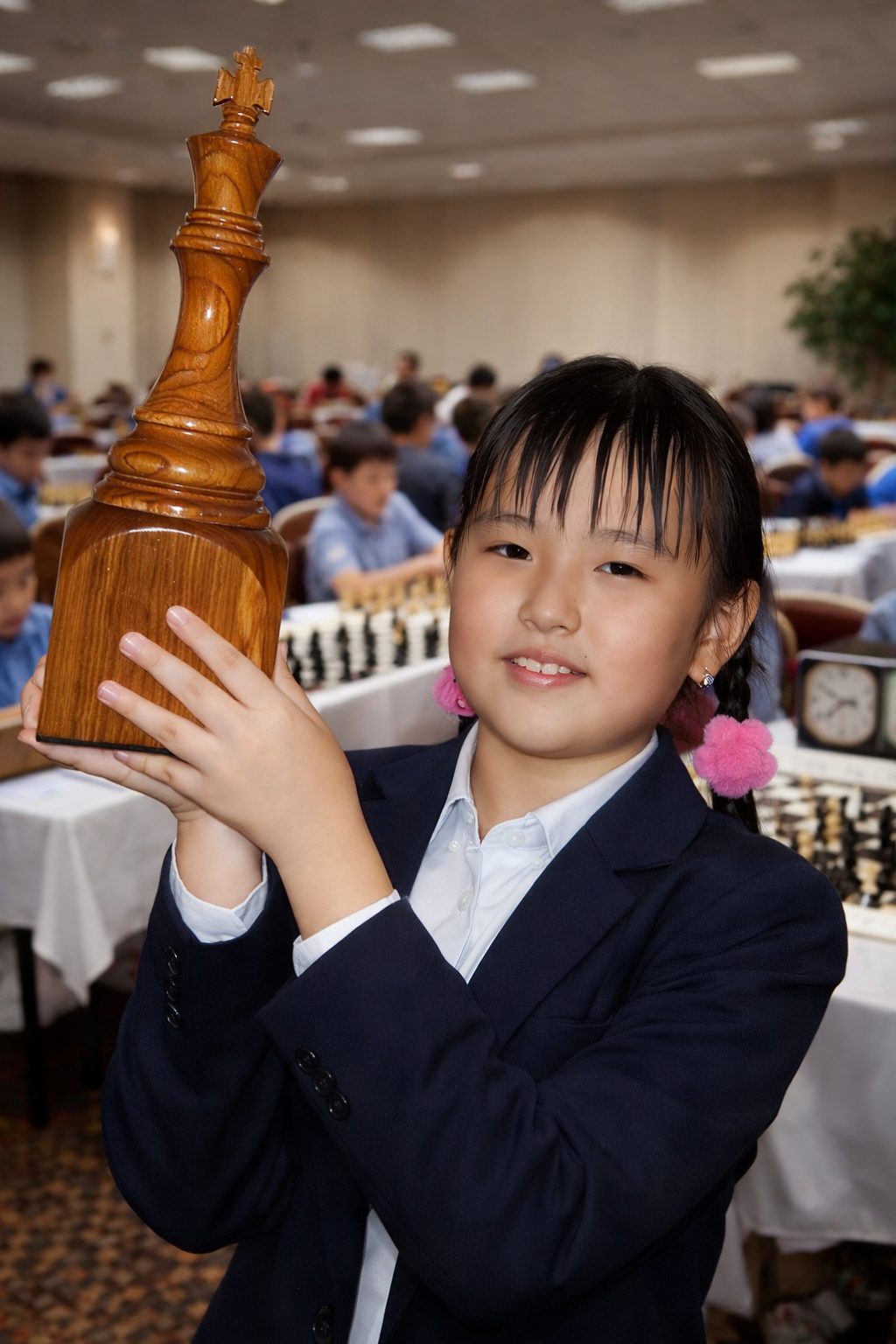
A young girl holds a giant teak king at a youth tournament — her smile capturing the courage, resilience, and quiet confidence that chess quietly installs in every player who dares to think ahead.
Small Hands, Grandmaster Dreams: How Youth Chess Is Redefining Victory
Victory does not always come in the form of a gold medal or a cash prize. Sometimes, it is shaped like a giant wooden king, polished to a warm glow, and held by two small hands that can barely wrap around its base. At a recent youth chess tournament, one young player’s proud smile said it all: in chess, the biggest wins are often measured in courage, not size.
The photo captures a moment most chess parents know well. Behind her, dozens of kids sit hunched over 64 squares, clocks ticking, futures unfolding one move at a time. But for this girl, the tournament was already won. The oversized teak king she’s holding isn’t just a souvenir. It’s a symbol. It represents hours of practice, the sting of losses that taught resilience, and the quiet confidence that comes from outthinking an opponent twice your age.
What makes youth chess so powerful isn’t the promise of becoming the next Magnus Carlsen. It’s the skills the game quietly installs. Kids learn to sit with uncertainty. They learn that one impulsive move can undo 20 good ones. They learn to shake hands after a brutal loss and say “good game” even when it doesn’t feel good. That’s emotional regulation you can’t teach from a textbook.
Wooden pieces like the one in her hands also tell another story: chess is tactile, physical, and beautiful. In an era of screens and swipes, there’s something grounding about the weight of a hand-carved teak king. It connects young players to centuries of tradition, from Persian courts to Russian chess schools. It turns an abstract battle of the mind into something they can hold, admire, and remember.
Tournaments like these are growing across Asia, including Indonesia. More schools are adding chess to after-school programs because it boosts concentration, pattern recognition, and academic performance. Studies from the American Foundation for Chess have linked regular play to improved math and reading scores. But ask any kid what they love, and they’ll tell you: it’s the thrill of a good trap, the silence before a checkmate, the friends you make between rounds.
For parents wondering if chess is “worth it” for their child, look at her face. That’s not the expression of someone memorizing openings. That’s pride. That’s ownership. That’s the look of a kid who just realized she’s capable of big things. You don’t need to be a prodigy to get that feeling. You just need a board, an opponent, and the guts to play.
So here’s to the kids who lose their first five tournaments and still come back for the sixth. Here’s to the oversized trophies that don’t fit on a shelf but fit perfectly in a childhood memory. And here’s to the next generation of thinkers, one wooden king at a time.
Because in the end, chess doesn’t just teach kids how to win games. It teaches them how to win at patience, at strategy, and at believing in themselves long before the rest of the world does.
#YouthChess #ChessTournament #ChessKids #GrandmasterInTraining #ChessLife #MindSports #FutureChampion #ChessCommunity #TeakChessSet #GirlsWhoPlayChess